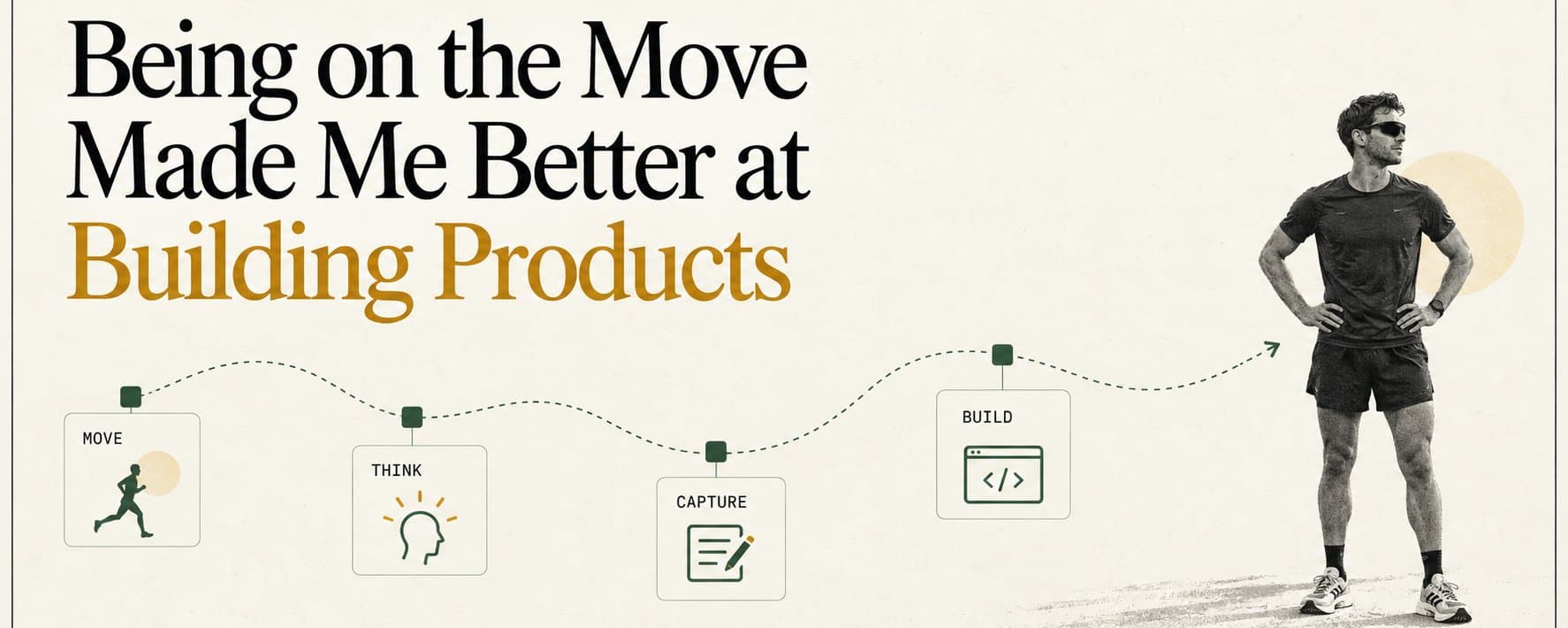
At the beginning of this year, I went for a 5K run.
Nothing unusual on paper. But afterward, I had to recover for much longer than I expected. My response was, naturally, to push harder.
I had decided that I wanted to prepare for an Ironman, so I started running almost every day. Usually four or five kilometers, often in the heat. I added workouts and heat sessions. Every week I tried to improve something: run farther, run faster, do more.
Then I kept wondering why I was so tired.
This pattern took me longer to understand than it should have. I would feel good, increase the load, and quietly overtrain. Then I would lose close to a week recovering. The thing I was doing to become more productive was making me less capable of working.
But stopping activity entirely made everything worse in a different way.
When I do not move, I stress more. I may spend more time at the desk, but my thinking gets narrower. Small problems feel heavier, and I can sit there trying to force a solution that appears on its own once I leave the room and start walking or running.
So I do not think of physical activity as something separate from work anymore. It is part of how I work.
When I get the balance right, I think more clearly. Work feels creative again. I feel more excited about life outside the work too. The time away from the computer does not feel like time stolen from building, because a surprising amount of the building is still happening in my head.
While I am running, walking, or working out, I am usually turning some part of a product around. I visualize how the tool should feel, what could be simpler, what is creating friction, or what I should change when I get back. I am away from the code, but I am still building. Often more clearly than when I am sitting in front of it.
Some of my best product decisions happen this way. Not because I am consciously trying to solve them. Usually I have stopped trying for a minute. My attention loosens, the problem rearranges itself, and suddenly the next step becomes obvious.
The difficult part has been finding the amount of activity that creates energy instead of consuming all of it.
My old instinct was to treat every week as a chance to beat the previous one. That works until it does not. Eventually the body sends a bill, and in my case the bill was usually several low-energy days where both training and work got worse.
Now I am trying to keep a repeatable routine instead of constantly escalating it.
Most weeks, that means three or four calisthenics and heat sessions. I run three or four times, usually around three to four kilometers or 20 to 30 minutes. I stretch every day and try to get roughly 10,000 steps through walking.
Written out, it sounds like a lot. But the point is not to turn every session into a competition. I do not need a personal record every time I leave the house. If the day has already been intense, the training can be lighter. The goal is to stay in motion and finish with enough energy to come back tomorrow.
This sounds less ambitious than the way I approached preparing for an Ironman, but it has made me more consistent. I can run, build, think, sleep, and repeat the process without needing to disappear for a week.
Balance is not something I naturally maintain. If I am excited about a product, I can sit and build for days. I start skipping walks, eating worse, sleeping less, and telling myself I am being productive. Usually I am just becoming more obsessed and less useful.
The same is true in the other direction. Too much training takes energy from the work. Too much work makes the work worse.
What seems to help is rhythm. I start the morning with some kind of activity before jumping into the computer. I work for an hour or maybe 90 minutes, then break the state. Walk, stretch, train, or simply let my mind move somewhere else for a while.
This is also one of the reasons I made Capture.
Ideas do not arrive when I have a neat page prepared for them. They arrive halfway through a run, during a walk, after training, or while I am doing something else entirely. I wanted a way to say the thought as it came and trust that it would still be there later.
No setup. No organization ritual. No deciding whether the thought is a note, task, goal, or project before it is allowed to exist.
Capture completes the loop between movement and building. When one of those thoughts becomes clear, I can say it immediately and keep moving. The idea, task, or goal does not have to wait until I am home, and I do not have to interrupt the state I am in to organize it.
Movement helps me find the thought. Capture makes sure I do not lose it.
It has also changed how I build Capture itself. I can spend a run mentally using the product, noticing where it should be faster or simpler, and imagining what would make it more useful. Then I can record those decisions in the same tool while they are still fresh.
I am still learning where the line is. I still overdo it. I still sometimes confuse intensity with progress. But I am more convinced now that physical activity is the most important part of my productivity system.
It is not an optimization after the work is done, and it is not a reward for finishing. It is what keeps me clear enough to do the work at all.
The goal is no longer to see how hard I can push today. It is to create enough energy to think clearly today and still want to return tomorrow.
If you are like me and need a companion to catch the ideas, tasks, and goals that appear while you are moving, that is what I built Capture for.
You can try it at https://trycapture.app