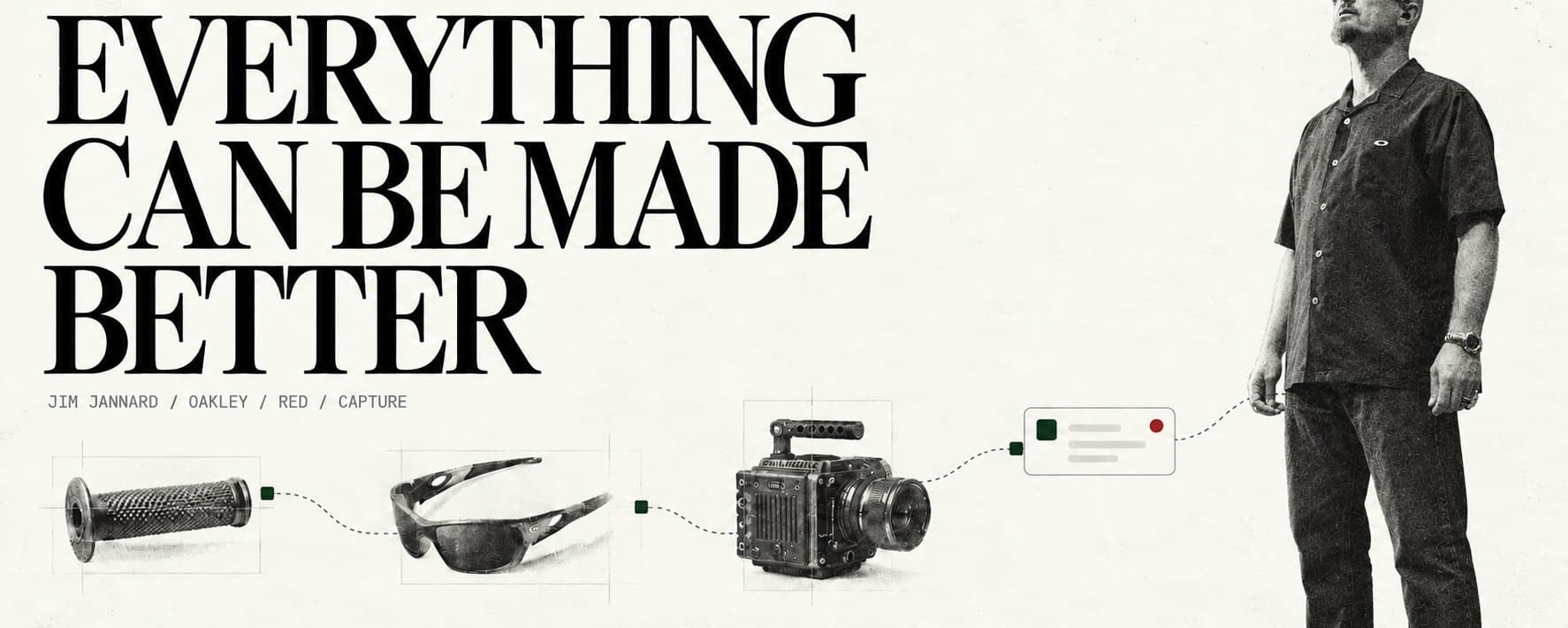
It’s just a matter of when and by whom.
I’ve listened to Jim Jannard’s interview on Factory Pirate Radio four or five times now. He founded Oakley, then RED, but the part I keep returning to is not really about either company. It is how he connected making a better product with having a story worth telling.
Before Oakley, Jannard sold motorcycle parts out of a thick distributor catalog. Most of the products were also sold by his competitors, so winning business came down to personality, weekly discounts, and delivery. Then a magazine tested several motorcycle expansion chambers on a dyno, and one made by Bassani won by a wide margin.
Now he had something his competitors did not: a real advantage. And because the advantage was real, he also had a story.
He says selling suddenly became easy. That experience gave him a rule he kept returning to: the worst thing a product company can say is, “I have the same thing, only cheaper.” That is not a story. The product has to be better, different, or unique in a way people can actually feel. The story cannot be pasted on afterward.
Years later, when he needed a bank loan for the tiny company he was running from his garage and van, he was asked for one sentence explaining why anyone should lend him the money.
“Everything in this world can and will be made better. It’s just a matter of when and by whom.”
The banker asked if he was one of those people. Jannard said yes. He got the loan.
That belief became Oakley. Make it work better. Make it look better. In his words, build “inventions wrapped in art.” The product satisfies the mind because it works, the eye because it has a point of view, and hopefully the heart because it makes you feel something.
I think I’ve replayed this interview because I’m trying to learn the same lesson from the opposite direction.
Building is the part I naturally retreat into. I can keep fixing, adding, and testing, then tell myself the product needs one more thing before I talk about it properly. Today I captured a note that I need to spend at least as much energy making connections, doing outreach, and writing as I spend building.
A good story matters. But Jannard’s version of a story is useful because it does not give builders permission to manufacture one. First, something has to be genuinely better.
Capture is my attempt at that.
There are already endless apps that save information. I did not need another empty place to put text. The part I wanted to improve was what happens a few seconds earlier, while the thought is still rough.
A thought rarely arrives as a clean note. It might contain a task, a decision, a bug, and an unfinished idea in the same paragraph. Most software asks me to untangle it first. Pick the page. Name it. Choose whether it is a task or a note. Add a tag if I want to find it again. I’m already doing work for the system before it has helped me.
Capture starts with “say it however it comes out.” It sorts the text into Actions, ongoing Threads, and Intentions. Related thoughts can build context instead of becoming another pile of dated notes. The point is not to help me maintain a better filing cabinet. I do not want to maintain one.
Of course, immediately after I captured the idea for this article, Capture gave me two reminders that it is not finished. It kept a whole paragraph as one action when it should have separated several actions. Another thought about writing landed in the wrong thread. I captured both bugs in Capture, which is at least very on brand.
I don’t want to hide that part. “Everything can be made better” only means something if I’m willing to see what still isn’t good enough.
One of the next experiments is using Jev, a model built for structured decisions, to improve how Capture routes and classifies what I give it. I also want to make the accumulated record useful in a new way: ask Capture a question and let it answer from everything I have recorded so far.
Not another generic chatbot. More like being able to ask, “What have I already decided about this?” or “How has my thinking changed?” without manually rebuilding the context every time.
That is where I think the real story is.
Capture is not “AI notes.” It is for the moment before a thought has become a note, task, or decision. It is based on a simple belief: a thought does not need permission to exist. It should not have to arrive neatly organized before software can help.
Jannard also says that once you have a product worthy of stories, you still have to tell those stories to the right customer effectively. I have been weaker at that part. Building something better is not automatically enough, and marketing is not separate from the work. Done honestly, it is how you explain what changed and why it matters.
Capture is still imperfect. I’m still finding places where it sorts something wrong, makes a strange decision, or creates more friction than it removes. But this is the gap I chose to work on: the few seconds between having a thought and losing it, flattening it, or turning it into organizational work.
That gap can be made better. Capture is my attempt, and now I need to get better at telling people why I think it matters.
Source: Jim Jannard // Origins of Oakley, Factory Pirate Radio