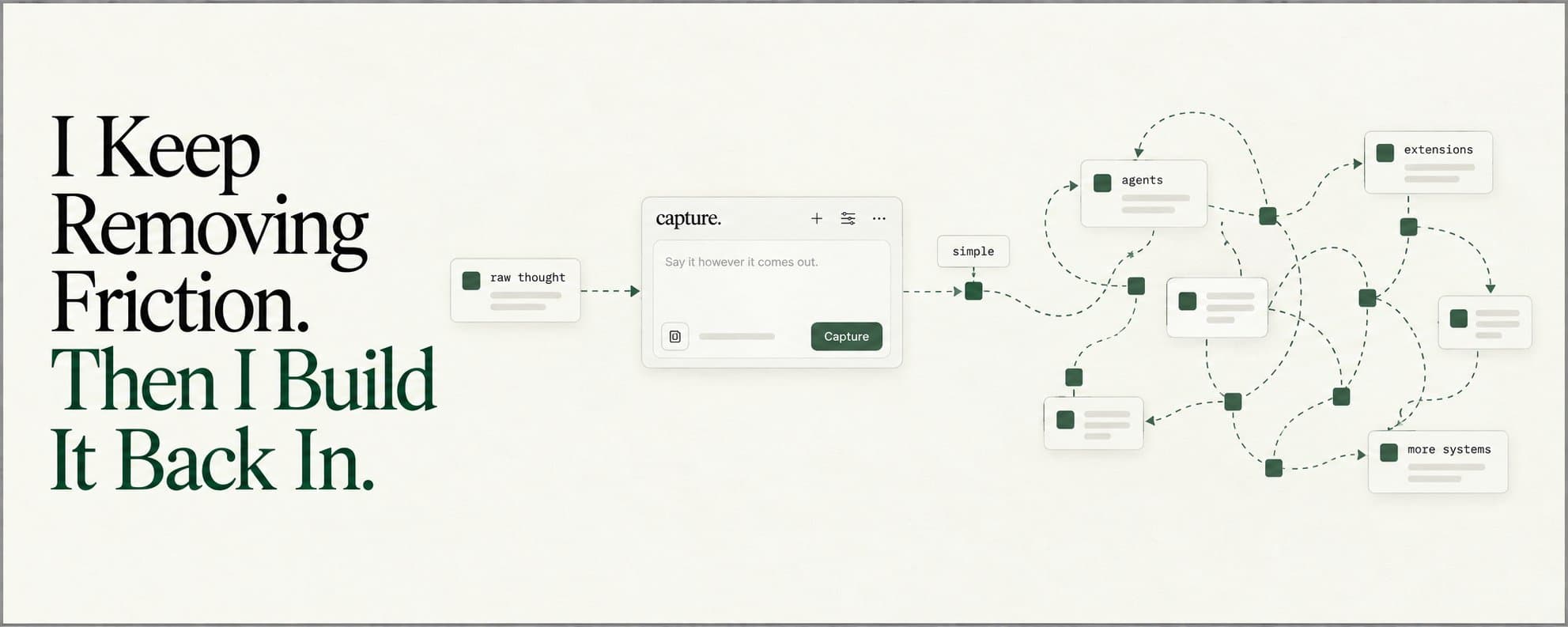
I have a very interesting problem: I like to overbuild and perfect things. This usually happens right after I solve something. Capture started because I wanted to talk while walking without deciding where every thought belonged. I wanted to say something, let the app sort it, and come back to it later.
That part works. Then I start thinking about extensions, mind maps, shared boards, automatic tagging, daily rituals, new views, and several other things that might be useful. Or might not. Suddenly the tool I built to remove decisions gives me another hundred decisions to make.
The part of Capture I use most is still simple. I talk. It sorts the thought. Later, I find it again or give it to an agent. Everything else has to earn its way in.
The lowest-friction version of the goal
I started asking myself a question: What does the lowest-friction version of this outcome look like for me? Not the most impressive version. Not the version with the largest number of agents, automations, and interconnected systems. Just the version I would actually keep using.
Writing is a good example. I want to publish more, but sitting down and deciding to "write an article" turns it into a whole project. I start editing the opening before I even know what I'm trying to say. I think better while moving, so the lowest-friction version is probably to walk, talk the article into Capture, let AI clean up the transcription, and then edit it myself.
That does not remove me from the writing. It removes the blank page.
Retake came from a similar problem. Recording a product demo can turn into scripting, retakes, editing, zooming, and doing the same thing again because the cursor moved slightly wrong. The useful outcome is the demo. Everything around it is friction.
I tried to automate everything
At one point I started building an entire AI system. I wanted to notice a bug on my phone, send it to an agent, let another agent fix it, and have someone else test the result. I was thinking about developer agents, testing agents, lesson-planning agents, and personal agents that could handle things like bookings and errands.
Some of this is still useful, but I started on the wrong foot. I was building the entire machine before making sure the smallest workflow worked reliably. The system that was supposed to remove friction became another system I had to maintain.
This sounds obvious when I write it down. I still keep doing it.
The friction I have not solved
Capturing ideas is mostly solved for me. Writing and publishing are getting easier now that I can speak while walking. The part I am still weakest at is finding people to try what I build.
I do not naturally follow up or stay in contact with people. I would rather go back to building something because that part is fun for me. I am trying to reduce that friction with better workflows and tools, but I do not have a clean answer yet.
Maybe some of it can be automated. Some of it probably still requires me to talk to people. I'll figure that one out as I go.
Friction is not the same as effort
I do not think the goal is to remove effort from everything. Running takes effort. Building a useful product takes effort. Learning something properly takes effort. Friction is the part that makes me avoid the useful effort before it begins.
Deciding where to save a thought. Preparing the same thing again. Recording the same demo several times. Maintaining a complicated automation that saves ten minutes per week. Those are the parts I want to remove.
Spotting them has also become one of the best ways for me to find product ideas. Instead of asking what product I should build, I can look at what I keep trying to do and ask why I am making it so difficult.
Then I can build the smallest thing that makes the useful action easier. And hopefully stop before I add all the friction back in.