I built Capture three weeks ago. The reason I built it goes back much further, to roughly 400 notes divided between Google Keep and Apple Notes.
Keep was where I put ideas about things I was building. I would have a thought, add it to a note, then return to the same subject later and add another. After a while, calling them notes stopped making much sense. They were already threads. I was thinking over time, but the software could only make the page longer.
Apple Notes did exactly what it promised. It kept everything. That was also the problem. With enough material inside it, saving something and being able to find it started to feel like two different things.
One more inbox would not have helped. I already had places to store text. The friction came from the small filing decision attached to every thought: what is this, and where does it belong?
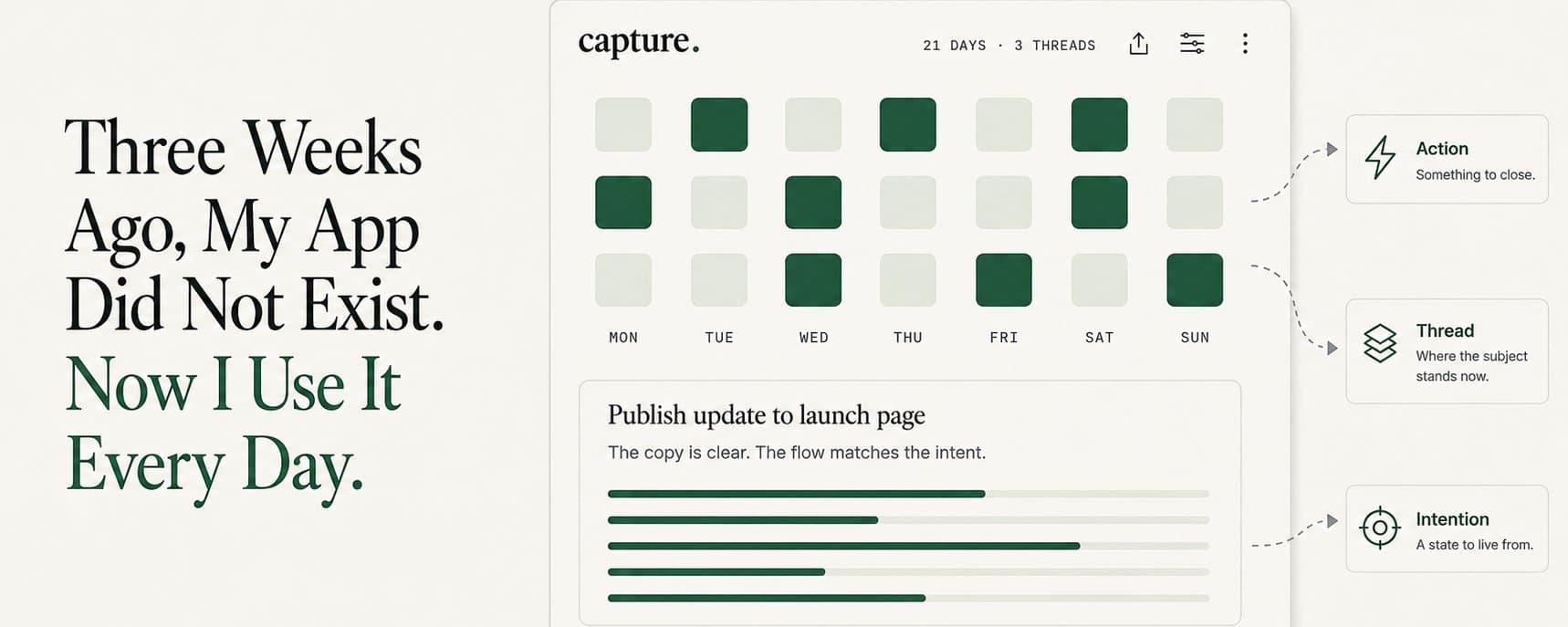
Capture changes the order. I say something however it comes out. The app decides whether it is an action, a thread, or an intention.
That is how I use it now.
On my phone, I started with dictation. Sometimes it was good. Sometimes it was shit. I could speak quickly, but I could not trust what would arrive, and that uncertainty created its own little resistance.
I did not want a large monthly bill for a transcription app. More recently, I found Local Whisper. It cost about $5 once and works well for this part of the process. Local Whisper was not the reason I built Capture. It arrived later and made a workflow I already had more reliable.
On my computer, I use Hex to talk with Hermes. When a conversation produces something I want to keep, I copy the history into Capture. Code ideas go there too, along with product changes and things I notice about myself.
Storage was already solved. Capture lets me think without asking me to file the thought at the same time.
The three categories came from habits I already had. An action has something to close. A thread keeps collecting thoughts and shows where the subject stands now. An intention holds a state I want to live from without turning it into another progress bar.
I did not design those categories as a product framework. I noticed that I kept returning to the same three shapes, so I put them in one place.
I use Capture every day, which makes its failures hard to ignore. I notice when I hesitate before opening it, when I copy something twice, or when a thought disappears before I get it in. I also notice when I avoid the app because I expect it to give me more work.
That gives me something concrete to fix. If the next use feels easier, the change worked. If I still hesitate, the design is not finished.
Some details matter even though they do not make Capture more capable. It has a heat map. Thread cards develop thin sediment lines as thoughts collect. I notice both.
They show that something happened without asking me to study a dashboard. Together they make the app feel quietly alive. A useful tool can still contain small things that are simply good to look at.
Knowing when to stop is harder. Once a tool works, every new idea can sound like a reason to make it larger: profiles, maps, graphs, agents, more content types. Any one of them might be useful, but together they could bury the reason I open Capture in the first place.
Daily use gives me a stricter filter than interest alone. I need to feel a feature's absence, or it needs to improve something I already do without making that action slower.
I want more people to try Capture. It is free, open source, and self-hosted. Their friction will be different from mine, which is part of what I want to learn.
Tomorrow I will have another thought while walking, working, or talking with Hermes. I will want to keep it without stopping to decide where it belongs.
Capture has to earn its place again in that moment.